Proving What the Books Say Is True: Don Quixote as Columbus in Foucault’s The Order of Things

Michel Foucault’s The Order of Things is at least as remarkable, to me, for what it does not say in its opening chapters as for what it does say.  As its readers know, its second and third chapters (“The Prose of the World” and “Representing”) describe the dramatic shift in Europeans’ understanding of language’s relationship to the world that occurred between the 16th and 17th centuries: a shift from a time when “[t]he truth of all these marks–whether they are woven into nature itself or whether they exist in lines on parchment and in libraries–is everywhere the same: coeval with the institution of God” (34) to a time when, with the important exception of literary language, “the arrangement of signs was to become binary, since it was to be defined, with Port-Royal, as the connection of a significant and a signified” (42).  However, Foucault offers no explanation for why this shift occurred.  He does indirectly give a name to the time during which it occurred–the Baroque (he devotes a single, rather dismissive paragraph on p. 51 to a description of its attributes)–and identifies Cervantes’ Don Quixote as the Baroque’s avatar, but he has nothing more to say on the matter.

In his early speech (which later became an article) “Of Other Spaces: Utopias and Heterotopias,” Foucault names Galileo’s confirmation of Copernicus’s heliocentric model for what we now call the solar system as the cause for the intellectual shift from medieval to Renaissance understandings of space.  Thus, we know that Foucault is more than capable of identifying significant events whose consequences reverberate through time and culture.  Yet in The Order of Things, he does not.

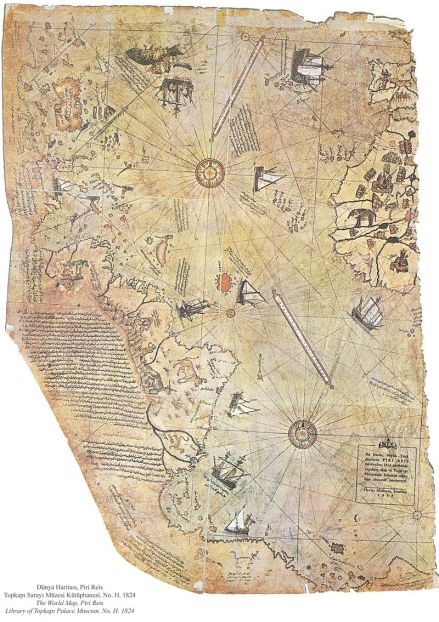
I do not pretend to know why Foucault is silent on the cause for this profound shift in Western thought, but I can tell you what I think he should have said that cause was: Columbus’s arrivals in the Americas. There’s nothing like a culture’s encountering two enormous landmasses completely unaccounted for by the Bible to thoroughly shake that culture’s previously-unquestioned assumption that language is “coeval with the institution of God.”  However, perhaps Foucault does mention the Americas-as-cause indirectly, through a bit of projection.  In the preface to The Order of Things, he mentions the ficciones of Argentinian writer Jorge Luis Borges as an inspiration for his idea of heterotopias, and several of the examples of heterotopias he provides in “Of Other Spaces” are from the Americas.  To some extent, then, Foucault thinks of the Americas and at least some of its cultural products as disruptive in comparison to European conceptions of space and language.  Meanwhile, in the sub-chapter on Don Quixote in “Representing,” Foucault could not have provides us, through his discussion of the Knight of the Sorrowful Countenance, a better description both of how Columbus understood the space through which he sailed and how his understanding looks to us today.
Continue reading

Early-summer reading

Baroque New Worlds

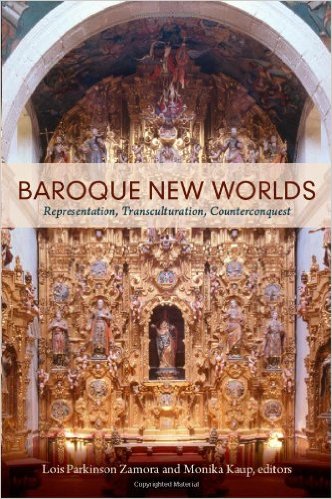
The cover for Baroque New Worlds.

Despite the radio silence here at the blog since my last post (apologies for the mixed (technologies) metaphor there), I have been doing some final editing and emendation of already-written chapters, soliciting colleagues to have a look at said chapters, and (as this post’s title indicates) getting some reading done.  Now that the semester is done and I am done with doctors’ appointments and have returned from a visit with my daughters and my mother, I am about ready to settle into working on the next chapter, which uses as its starting point Alvar Núñez Cabeza de Vaca’s account of his eight-year (1528-1536) journey across Texas and northern Mexico and will lead to a discussion of texts that, in various ways, use, modify, and otherwise play with language so as to better convey the experience of living in this hemisphere.  Before I get to that, though, I have some minor additions to make to the earlier chapters, for which I have two books to blame (and be grateful).

Continue reading

“His normal sensitivity to negro behavior”: Looking for black and heterotopic spaces in Go Down, Moses

eudorawelty19---Home-By-Dark-2319x2888

Eudora Welty, Home by Dark/Yalobusha County.  1936.  Via.  This is also the cover image for the 1990 Vintage edition of Go Down, Moses.

What follows is some thinking-out-loud that will be part of the chapter on Go Down, Moses and Tent of Miracles–specifically, an attempt to tie together land and cultural expression in the two novels.  (Progress report: It’s coming along, but it has felt at times like I am a vulture circling high in the sky over an animal to make sure it is dead before I will alight on it.  I’m pretty sure it’s dead now.)

It’s below the fold to spare those who won’t be interested; here, though, is the tl;dr version: 1) At the time he wrote it, Go Down, Moses was Faulkner’s most intimate exploration of not just black-white relations but of black lives and black interiority.  Still, though, it is a novel that is ultimately more concerned with white attempts to come to terms with the post-bellum South.  Thus, those glimpses of black lives we have are (mis)read by whites, but some of them resist any attempt to read them.  This brings me to: 2) You can learn a heck of a lot about how to read Faulkner from Minrose Gwin.

Continue reading

Pedro and Ike and Culture and Land: Some Comments on Tent of Miracles and Go Down, Moses

tenda-dos-milagres-jorge-amado-

The cover of a Brazilian(?) edition of Amado’s novel, via (though this particular copy of the book is no longer for sale at that site).

I have begun my reread of Brazilian writer Jorge Amado’s novel Tent of Miracles, which I have paired with Faulkner’s Go Down, Moses in chapter 2 of the book project. I’ll start off this post by making a couple of points regarding Ike McCaslin’s relationship to the land, and then I’ll make some comparisons between that and Tent of Miracles‘ treatment of Bahia, along with some initial remarks comparing Ike to Tent of Miracles‘ protagonist, Pedro Archanjo.  A good starting point for where I will be headed, though, is to compare the cover art for the Amado novel (which appears to be a scene from the 1977 film version) with that of the first edition of Go Down, Moses, which I posted here.  Though admittedly a bit of a cherry-pick on my part, that cover, with its depiction of a vast landscape empty of people, contrasted with the cover of Amado’s novel–the frame crowded with people, dressed and equipped with a fusion of Western and African-diaspora clothes and instruments–serves quite nicely as a starting point for this post.

Continue reading

What does Roth know, and when does he know it? Some further thoughts

One of the sharecropper's houses with sweet potatoes and cotton on the porch, Knowlton Plantation, Perthshire, Mississippi Delta, Mississippi, 1939

A sharecropper’s house, with cotton and sweet potatoes on the porch. Knowlton Plantation, Perthshire, Mississippi, 1939. Via.

To the reader: This is a follow-up to my most recent post.  It’s not crucial that you read that one before proceeding with this one, but it certainly wouldn’t hurt.

I think that what follows is more speculative than anything else; whatever legitimacy these claims have rests on the textual fact that the “now” of Go Down, Moses‘ section “The Fire and the Hearth,” set in 1941, takes place (depending on whose genealogical chart one consults) one or two years after the “now” of “Delta Autumn,” even though sequentially, “The Fire and the Hearth” appears second in the novel, while “Delta Autumn,” appearing sixth, serves as the novel’s climactic section.  Thus, even though Roth Edmonds (who figures prominently in both) never hints, not even obliquely, in “The Fire and the Hearth” that he’s ever had a lover, much less that she was a black woman by whom he’d conceived a child, and very much less that, as we learn in “Delta Autumn,” she and Roth are distant cousins, it’s reasonable to begin by assuming the events we learn of in “Delta Autumn” have a shaping influence on Roth’s actions and, more crucially, thinking in “The Fire and the Hearth.”  The trick is in the locating of those influences.  Maybe I have found some of those moments, without being guilty of squinting too hard at them.

(Note: What with the beginning of the new semester all but upon me, I really shouldn’t be taking the time I’m taking to post on this at all, much less shape it into a more elegant form; what follows, then, are more like notes than anything else.)

Continue reading

What does Roth know, and when does he know it? Chronology and names in “The Fire and the Hearth” and “Delta Autumn”

McCaslin genealogy

The McCaslin-Edmonds-Beauchamp genealogy in Go Down, Moses. Via.

Go Down, Moses is a tangle of a novel, both chronologically and genealogically, as this chart shows.  I already knew these things, of course.  In the course of my rereading, though, I am finding it to be even more tangled than in just the ways I had realized or had intended to address in the book project.  Two of those tangles are the sequencing of the stories (almost all of which, just to remind the reader, had prior existences as short stories) and the material Faulkner added to them in order to unify them into his novel.  The sequencing has nothing to do with chronology but, I am rather sheepishly realizing, with the gradual revelation of the extended McCaslin genealogy; the link to the webpage where I found this chart does a good job of tracing out the tree as each novel’s section in its turn reveals its branches.  (In this regard, Go Down, Moses‘ gradual, decidedly unchronological revelation of information from various sources/directions most strongly resembles Faulkner’s other great examination of the tragedy of slavery, Absalom, Absalom!)  But more to the point of this post, I have found myself paying closer attention to Carothers “Roth” Edmonds, whom the novel introduces us to in “The Fire and the Hearth.”  Roth is the man who now owns the McCaslin plantation that Ike McCaslin had refused to accept as his inheritance, and he is also, as we’ll learn in “Delta Autumn,” the father of the baby the woman brings to the hunting camp in hopes that maybe, finally, Roth will acknowledge them.  Lucas Beauchamp is “The Fire and the Hearth”‘s central figure, but he will barely figure into Go Down, Moses‘ other sections.  Rather, it is through Roth that “The Fire and the Hearth” introduces the novel’s central mystery: Why Ike has refused to take ownership of the family land.  This post’s subject, though, is a smaller mystery, one that, for me, anyway, has the potential to make Roth a more sympathetic figure than most take him to be.

Continue reading

La Conquistadora–Some Concluding Thoughts

La-Conquistadora-The-Virgin-Mary-at-War-and-Peace-in-the-Old-and-New-Worlds

[Update: Here is the link to the review.]

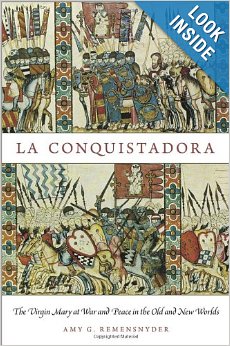
I (finally!) finished reading Amy G. Remensynder’s book La Conquistadora: The Virgin Mary at War and Peace in the Old and New Worlds, and have sent off a review of it to H-Net; I’ll post a link to it as soon as it’s published there.   Here, I thought I’d add some remarks that didn’t make it into the review but which have a bearing on the book project, at least some of which amount to editing my earlier remarks here.

Continue reading

Book Project Notes: Transcribing and Re-orienting Chapter II

go-down-moses

The first-edition (1942) jacket for the novel Faulkner wanted to be called simply Go Down, Moses. Image found here.

It’s been a while since I have reported on my progress on the book project.  I thought I’d use this post to both comment on that and to do some sketching out of some work on it I’ll be taking up over the Christmas break.  To spare the uninterested, the rest of this post will appear below the fold.  If you do click to read on, apologies in advance for some of the Inside Baseball quality of what you’ll run into.

Continue reading

Agamben’s Concept of Homo Sacer

I first learned of political philosopher Giorgio Agamben earlier this year via this long review article by Adam Kotsko in the Los Angeles Review of Books.  Since then, I’ve not exactly been a diligent student of his, but Kotsko’s discussion of Agamben’s book The Highest Poverty: Monastic Rules and Form-of-Life, struck me as having resonances with Foucault’s notion of heterotopia which, as the tens of readers of this blog may recall, has considerable importance for my book project.  My long-time Internet friend Kári was kind enough to send me a copy of that book when he learned of my interest in Agamben, and he also has the useful habit of posting things about Agamben on his Facebook feed from time to time.

Anyway, speaking of Facebook, this morning the video below popped up as a Suggested Post; it’s an 8-minute condensed presentation of Agamben’s central idea, the Homo Sacer, or “sacred man,” and its gradual loss as monarchies have evolved into democracies (and totalitarian states) and biology has become the chief determinant of the individual’s value in society.  If any of this sounds the least bit interesting to you, I encourage you to watch this.