“A Marian geography of Christian Spain”: Some early comments on La Conquistadora

La-Conquistadora-The-Virgin-Mary-at-War-and-Peace-in-the-Old-and-New-Worlds

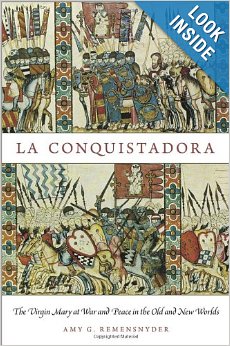
La Conquistadora: The Virgin Mary at War and Peace in the Old and New Worlds, by Amy G. Remensnyder

La Conquistadora is the next book I will be reviewing for H-Net.  I’m not even halfway through this massive book–in its chronicling of the Reconquista of Iberia from the Moors, I have only just now reached the crucial year of 1492, only to see it backtrack a bit in Part II to talk about how Mary was an object of veneration for Muslims and Jews as well as Christians, even as she was also called upon by Spanish kings and aristocrats to fight on the side of Christian armies.  In the third section, Amy Remensnyder’s book will discuss Mary’s career in this hemisphere, which, given my book’s interest in discussing (New Spain’s) Virgen de Guadalupe, should make for engaging reading–not that it hasn’t been so far.  (What disappointment I feel is simply that I’m not further along in reading it than I am, and not with the book itself.)

Already, though, some of the claims Remensnyder has made about how Mary has been invoked and venerated during the Reconquista seem to mesh with observations made by Serge Gruzinski regarding miraculous apparitions of the Virgin in Tenochtitlan/Mexico City in his crucial book on Mexican iconology, Images at War: Mexico from Columbus to Blade Runner (1492-2019).  Below the fold, I want to talk my way through some of that without making an argument, seeing that, as I noted, I haven’t yet reached Remensnyder’s discussion of Mexico.  But I especially want to muse a little on her elegant phrase “Marian geography.”  I’m betting she will use it when discussing this hemisphere, but (again, without yet knowing what she”ll say) I’d like to try to put a New World spin on that phrase that differs from the one it has so far had in her book.
Continue reading

Teaching Idea: Reading a Painting

Edward Hopper conference-at-night

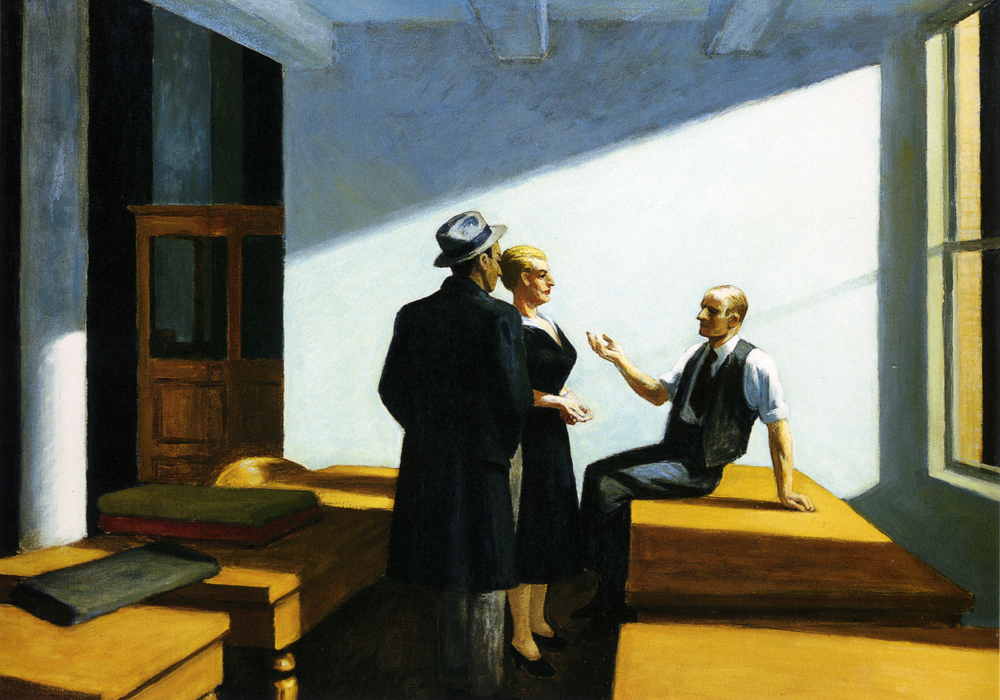
Edward Hopper, Conference at Night (c. 1949). Wichita Art Museum. Via wikipaintings .org.

None of what follows pretends to be something no one has ever thought of before, much less done before.  I’m writing about this, though, in part to push myself with being a little braver with how I use images in class as a way of encouraging my students to look more closely at them and, perhaps, at traditional texts as well.  So, bear with me.

For many years now, I have used paintings as in-class writing prompts, as entrees into discussions of certain topics, and as the subjects for paper topics, and last year I created a prompt which asks student to write about a still from a film’s 70-minute mark–both the contents of that image and what it might reveal to us about the film as a whole that an uninterrupted viewing does not.  (In case you’re interested, my inspiration for that idea comes from here; and here is my attempt to do the assignment myself (I am asking students for a minimum of a thousand words): 70-Minute Casablanca).  I’m sharing all of this with you now, though, because our department chair has encouraged us to work with our students on becoming more attentive and patient readers, and it occurred to me that, in addition to modeling the reading of a couple of poems with my students, I could throw a painting into the mix as well.

One of my favorite paintings to use in class is the one you see here, Conference at Night.  It’s a great painting by a great painter; it lends itself well to class discussions (even by Hopper’s standards, this one is especially enigmatic, appearing to be rather “So what?” at first glance but then becoming more interesting as we discuss it); and it happens to be here in Wichita (some of my students in the past have gone to see it in the museum after our having talked about it in class).  (Just as a quick addendum, I also love using paintings by Vermeer in class, but they require more historical setting-up, which delays getting on with the discussion; I’ve also used some paintings by Magritte for short in-class writing prompts, but it’s harder (for me) to have a sustained discussion about them–they’re a little too enigmatic.  I’ve yet to try a non-representational piece for this.)  It so happens that last week, we had lively discussions about it in both of the classes that looked at it.  Below the fold, I’d like to share some things that I say/ask about it to get conversation started, and some observations my students made on it; after that, I’ll do some musing about how to up the ante for making still more substantive use of it or some other, equally-suitable painting.

Continue reading

Book Project Notes: New Files Uploaded

On the “Domestic Issue” page (look for the tab under the header image), I have added a couple of .pdf files.  The first is my so-called “Columbus chapter,” which I finally have gotten into presentable shape (though it could still use some tightening up in places).  The second is an extended discussion of a frieze depicting the Virgin of Guadalupe’s final appearance to Juan Diego on December 12, 1531; this frieze is on the east side of the old basilica dedicated to the Virgin, which is located in Mexico City.  I am calling this latter piece an appendix, but it may yet find a home in a later chapter that will discuss the Virgin in more detail.  This second piece has been done for a while, but I thought I would post it with the other book-project material since it is at the very least an outgrowth of that other work, even if it does not find a comfortable home within the other chapters.

At any rate, I hope you will have a look and leave any comments or questions you may have.

Book Project Notes: Chapter II, Alternative Narratives, and Presuming to Speak

caroline-barr-the-faulkner-family-maid

Caroline Barr (1840-1940), the Faulkner family maid, to whom William Faulkner dedicated Go Down, Moses.

I have begun transcribing some of my dissertation’s second chapter into Domestic Issue‘s Chapter I.  This will consist of a comparative reading of William Faulkner’s Go Down, Moses and Jorge Amado’s Tent of Miracles, out of which will emerge both some further elaborations of ideas developed in the prologue for this project (the idea of the New World as a space whose difficulty in being read has its starting point in the land and/but manifests itself most overtly in human beings via racial intermixing, as articulated chiefly by Glissant and Santiago, with an assist from Foucault’s notion of heterotopia). I’ll also be rereading both these novels to account for any changes in my thinking and try to integrate, as needed, the ideas from the prologue.

Also making their appearance here will be two new ideas to throw into the mix.  The first, which I call Astonishment, is the narrative moment in which either the narrator or a character in the narrative (and maybe even on occasion, I will suggest, the writer himself/herself) is unable to articulate what s/he is experiencing.  In the texts I’ll be examining from here on out, Astonishment occurs when the narrator or character suddenly becomes aware that s/he is in the presence of someone of mixed race, but I will make the claim that it is also a trope for the initial Encounter between Europeans and the landmasses of the Western Hemisphere.  (By the way, Astonishment as I will be describing it in this chapter is not something that occurs in the so-called tragic mulatto narratives that were popular in this country in the 19th century; in those, the woman’s (with very few if any exceptions, the “tragic mulatto” character is a woman) origins are often so obviously telegraphed to the reader that when the revelation occurs, the only person surprised is the woman herself, and perhaps her would-be husband.)  Into that void of unarticulateable wonder rushes the rhetoric of Apocalypse, meant here in its twin senses of “destruction” and “revelation”: the wrecking of old orderings of and assumptions about the world, and the glimpse of the beginnings of a re-ordering that is not yet identifiable (here revisiting as well from the prologue the idea of the New World as an indeterminate space), which, certainly in the primary texts in this chapter but also in the ones to follow in this project, miscegenation certainly causes.

The other idea, which I will develop in the chapter that follows this one, is what I am calling “a language.”  I’ve italicized the “a” because Foucault argues that heterotopias have their own language; we cannot merely import languages from spaces outside them and expect them to be adequate to the task of describing who or what occupies those spaces.  The italicized “a,” therefore, is meant to indicate that that language cannot be just any already-existing language but one generated from within that space by its members; we, listening in on the language of this space, can identify it as a language but can comprehend it imperfectly at best.

So, then, that is the outline for the chapter.  Below the fold, I want to talk through a couple of (very) big-picture matters that have to do with my position relative to the materials I am working with, not to mention the arguments I’m making about those materials.

Continue reading

Teaching Idea: Prompt for “Build Your Own Micronation” research project

Sealand

The Principality of Sealand, established in 1967 and (self)-declared a nation-state in 1975. More here. Image found here.

Back in May, I posted about offering my students in Comp II, as an option for their research project, the chance to create and build a website for their own micronation.  Last night/this morning, I finally got something worked out that I think will work; it appears below the fold.

My hope is that this semester and next, at least a couple of students will give this a try so I can see what problems they encounter.  My long-term goal is to make the planning of a micronation the subject of a Special Topics course–something that gets called “English” but is actually interdisciplinary in its content.

Anyway, here it is.  If you have any thoughts or questions or concerns, I hope you’ll share them in the comments.

Continue reading

Greetings to students, and some things to think about

John and Scruffy

With his not-very-smart-but-friendly-and-faithful boon companion, Scruffy.

Hello to my students, both new and returning, this fall.  If you are reading this, I want to affirm your natural curiosity: A crucial part of being truly, fully successful at the College Thing is curiosity, and I encourage you to give free rein to that impulse in you–not just in your classes, either, but in Life more generally.  You can’t know whether something is going to be boring until you give it a chance to bore you, now can you?

As long as you’re here, I invite you to have a look around, and even leave comments if you’re so inclined.  Under the “About” tab you’ll find a brief bio and some basic assumptions I have about college.  The various tabs that have Domestic Issue in their title are concerned with my ongoing book project.  The “Teaching” tab is a round-up of examples of paper assignments for my classes; you’ll be seeing some of these as the semester progresses.  Finally, in addition to these posts, the “Home” page has links to various things that you may find of interest, if not actually helpful to you.

Now: if you’re really curious, below the “Continue reading” link you’ll find a long-ish discussion of what I think are some of the important questions that community colleges and their various audiences–students and their families, faculty and administration, businesses, and governments–are encountering and need to give some serious thought to.  All of those audiences will say that students are here “to get an education,” which is the right answer.  But if you ask them what that means to them, they may all list pretty much the same kinds of things, but I suspect that how they prioritize them will differ.

So.  If all of that sounds intriguing to you, by all means continue reading.  If not, that’s okay, too–as I said above, these ideas will still be showing up in various ways, mostly indirectly, as the semester progresses.

I wish you all the very best this semester.  It is my privilege to be teaching you.  I will try my best to do right by you.

Continue reading

Book-project Progress

It is the last day of July; next week, I will turn away from daily work on Domestic Issue in favor of getting things ready for the new semester, which begins in three weeks.  So, mostly just for me (but also, obviously, for anyone who happens to come upon this post), I thought I’d post a little “How I Spent My Summer, Scholarship-Wise” post.

Continue reading

Teaching Idea: “Build-a-brain” and the role of the emotions in consciousness

ex-machina

A still from Ex Machina. Image found here.

As part of my Comp II class, I assign groups of readings on various kinds of technologies and their potential impact on traditional notions of what it means to be human–in terms of both the self and our varied and various relationships with other people.  One set of those readings is on Artificial Intelligence: whether strong AI (which is to say, a genuinely thinking, understanding machine intelligence) is even possible; whether it’s a good idea to pursue this line of research; what the building of robots to serve as companions for humans implies for how we value (or not) interactions with others; the already-occurring displacement of workers by robots and machines performing tasks once done by people, and what to do about that displacement; etc.  I also assign them this short video in which Rosalind Picard of MIT provides what amounts to a short introduction on the need for and value of creating the capacity for emotional intelligence in robots that will be interacting with humans.  Picard is very precise here: she says that “emotional intelligence” is not the same as “emotion” and that we cannot yet build a machine with self-generated emotions.  She does, though, sort of wonder aloud what such a machine might look like, which is one of the ideas dramatized (to, I think, substantive and powerful effect) in this spring’s Ex Machina.  I had also been showing WALL-E as a way of showing a version of what emotional intelligence might look like in robots (as well as seeing a dramatization of a possible set of consequences of a post-human society for us as individuals and as communities); beginning this fall, though, I’ll be giving her a try: the fact that we never see Samantha in the film, but only Theodore’s responses to, um, her, gives us more to chew on, I think, regarding this issue of the distinction between emotional intelligence and emotion.  Without giving too much of the plot of Ex Machina away, that film raises that same issue, but seeing Ava and Caleb physically interacting with each other complicates matters considerably–for me, anyway.

That’s a lot of context just to be getting to the part in this post where I say, A couple of those readings have gotten a bit long in the tooth and/or are too obscure for what I want my goals to be, so when I ran across Michael Graziano’s thought-experiment/essay “Build-a-brain” a couple of days ago, I was glad to see that it can serve as a short, clear, and fairly sophisticated introduction to how we might achieve consciousness in a robot.  I think it might work equally well, by the way, as a way of helping students think critically–in this instance, to say, “Okay–I see what Graziano’s getting at . . . but is anything left out of his discussion of consciousness? And, for that matter, even though Graziano says that consciousness is a real thing and not illusory, does he really believe that?”

More below the fold.

Continue reading

So, why am I writing this book again??

To be clear, I’ve known why; however, someone looking at my vita and seeing where I teach now and where I’ve taught before, and how long it’s been since I obtained my doctorate, might wonder.  Why now, after all this time?  So, I’d like to point that person to this essay by David Perry (thanks to my FB friend Kendra Leonard for linking to it), and in particular to this paragraph:

For me, the key was realizing that I was writing this book solely for myself. I believed I knew some things about history that were important and would contribute to a field of study to which I have dedicated much of my life. I believed that the best way to communicate my findings was via a long-form monograph, rather than chopped into discrete articles. I did not, and do not, expect this book to transform my career. A new study shows that perceptions of prestige matter at least as much as quality of work in terms of hiring at top jobs, so no matter what I write, those perceptions are static.
In addition to Perry’s discussion of the academic and professional aspects of things, I would add two things.  One, it’s been immensely gratifying to do some reading of recent work on culture in Latin America and find that, on the whole, my arguments that I’d made way back when in the diss.  seem germane to these recent discussions (when, I confess, I had my doubts as I was writing the thing).  This is important to me because, given the nature of the classes I teach at Butler, I get little space in the classroom to explore these ideas, and I really need that intellectual outlet.  The other thing I would add that has been true for me is I tell my students: they will be more engaged, if not happier writers if, whenever possible, they can think of their academic writing as a creative act, as a form of self-expression.  To put things delicately, because I’m not up against a deadline, it’s been easy to, um, become distracted from the task; when I am working diligently, though, I’m learning things I hadn’t known I believed about New World writing, and I’m having a pretty good time in the process (even when, as now, I’m in the middle of unsnarling a rather tangled section of the Columbus chapter).  I’d also add as a corollary that if we’re regularly engaged in writing and researching, we can speak from those experiences as we teach, counsel, and advise our students regarding their own writing.
So.  I’m doing this because, as Perry says of his own book,  I think I have something to contribute to discussions about the literatures and cultures of the Americas, and–just as importantly–I want to have some intellectual fun.  I would hope that others of you who find yourselves in similar circumstances can see your way clear to say the same thing about your work.

The Land as Character in New World Writing: Some Initial Comments

John processing Nash

The keeper of this blog, processing–yes, let’s call it that: “processing”–Roderick Nash’s Wilderness and the American Mind, June 2015. Photograph by Megan Buaas.

In the Columbus chapter of the book project, I am at a place where I am trying to noodle my way through the idea that it is this hemisphere’s land’s There-ness, its resistance to being read in such a way as to conform to Europeans’ previous knowledge and assumptions about the world, that renders if not nonsensical then at least inaccurate not just Columbus’s claims that he had found Asia but, even, Europeans’ invention of the term New World–after all, Peter Martyr’s term in its essence simply says that this place fits neatly into what was already known about the world; Europeans just hadn’t known about this particular part of it before.  On the other hand, though, I’m trying to show that New World as appropriated by this hemisphere’s peoples does make rational sense because they do take into account, a priori, the land’s Thereness.  To that end, I have been reading/thinking through/writing a section in that chapter where I am presenting an overview of various writers and thinkers from throughout the hemisphere who in some way address how the land influences culture.  From there I’ll move on to making my argument for a different way of reading the texts of this hemisphere (that part is already pretty much written).  Very indirectly in this post on an early modern map of Tenochtitlan-Mexico City, I’ve already touched on this subject via my passing mention of Edouard Glissant’s argument about the land as character and my other reading of Latin American writers this summer has led me to other writers who seem to be saying much the same thing as Glissant without too much squinting on my part.  So, for the past couple of weeks I have been reading around in cultural writing from the United States from the 19th century, along with more recent interpretations of that writing, to see if somewhere in there might be traces of that same idea of the Thereness of the land and its fully-participant role in the shaping of culture.  The short answer is that, the Transcendentalists aside and much to my surprise, there really isn’t.

Below the fold, as I say in this post’s title, some comments; no real arguments, just some observations.  The more I think about this topic, the more I realize there is to say on it.  It’s not something I will pursue at any great length in the book project, but it will help me to enhance some thinking of mine in subsequent chapters–especially my discussion of Go Down, Moses, a novel in which the land figures prominently in Ike McCaslin’s thinking about his family’s history.

Continue reading