Early-summer reading

Baroque New Worlds

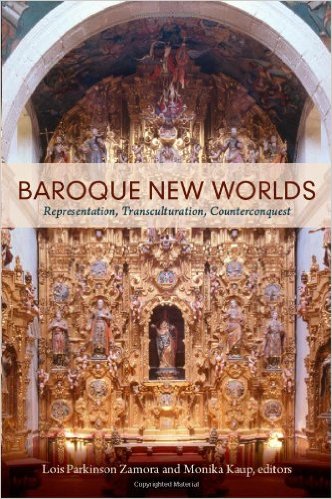
The cover for Baroque New Worlds.

Despite the radio silence here at the blog since my last post (apologies for the mixed (technologies) metaphor there), I have been doing some final editing and emendation of already-written chapters, soliciting colleagues to have a look at said chapters, and (as this post’s title indicates) getting some reading done.  Now that the semester is done and I am done with doctors’ appointments and have returned from a visit with my daughters and my mother, I am about ready to settle into working on the next chapter, which uses as its starting point Alvar Núñez Cabeza de Vaca’s account of his eight-year (1528-1536) journey across Texas and northern Mexico and will lead to a discussion of texts that, in various ways, use, modify, and otherwise play with language so as to better convey the experience of living in this hemisphere.  Before I get to that, though, I have some minor additions to make to the earlier chapters, for which I have two books to blame (and be grateful).

Continue reading

“His normal sensitivity to negro behavior”: Looking for black and heterotopic spaces in Go Down, Moses

eudorawelty19---Home-By-Dark-2319x2888

Eudora Welty, Home by Dark/Yalobusha County.  1936.  Via.  This is also the cover image for the 1990 Vintage edition of Go Down, Moses.

What follows is some thinking-out-loud that will be part of the chapter on Go Down, Moses and Tent of Miracles–specifically, an attempt to tie together land and cultural expression in the two novels.  (Progress report: It’s coming along, but it has felt at times like I am a vulture circling high in the sky over an animal to make sure it is dead before I will alight on it.  I’m pretty sure it’s dead now.)

It’s below the fold to spare those who won’t be interested; here, though, is the tl;dr version: 1) At the time he wrote it, Go Down, Moses was Faulkner’s most intimate exploration of not just black-white relations but of black lives and black interiority.  Still, though, it is a novel that is ultimately more concerned with white attempts to come to terms with the post-bellum South.  Thus, those glimpses of black lives we have are (mis)read by whites, but some of them resist any attempt to read them.  This brings me to: 2) You can learn a heck of a lot about how to read Faulkner from Minrose Gwin.

Continue reading

Pedro and Ike and Culture and Land: Some Comments on Tent of Miracles and Go Down, Moses

tenda-dos-milagres-jorge-amado-

The cover of a Brazilian(?) edition of Amado’s novel, via (though this particular copy of the book is no longer for sale at that site).

I have begun my reread of Brazilian writer Jorge Amado’s novel Tent of Miracles, which I have paired with Faulkner’s Go Down, Moses in chapter 2 of the book project. I’ll start off this post by making a couple of points regarding Ike McCaslin’s relationship to the land, and then I’ll make some comparisons between that and Tent of Miracles‘ treatment of Bahia, along with some initial remarks comparing Ike to Tent of Miracles‘ protagonist, Pedro Archanjo.  A good starting point for where I will be headed, though, is to compare the cover art for the Amado novel (which appears to be a scene from the 1977 film version) with that of the first edition of Go Down, Moses, which I posted here.  Though admittedly a bit of a cherry-pick on my part, that cover, with its depiction of a vast landscape empty of people, contrasted with the cover of Amado’s novel–the frame crowded with people, dressed and equipped with a fusion of Western and African-diaspora clothes and instruments–serves quite nicely as a starting point for this post.

Continue reading

La Conquistadora–Some Concluding Thoughts

La-Conquistadora-The-Virgin-Mary-at-War-and-Peace-in-the-Old-and-New-Worlds

[Update: Here is the link to the review.]

I (finally!) finished reading Amy G. Remensynder’s book La Conquistadora: The Virgin Mary at War and Peace in the Old and New Worlds, and have sent off a review of it to H-Net; I’ll post a link to it as soon as it’s published there.   Here, I thought I’d add some remarks that didn’t make it into the review but which have a bearing on the book project, at least some of which amount to editing my earlier remarks here.

Continue reading

Book Project Notes: Transcribing and Re-orienting Chapter II

go-down-moses

The first-edition (1942) jacket for the novel Faulkner wanted to be called simply Go Down, Moses. Image found here.

It’s been a while since I have reported on my progress on the book project.  I thought I’d use this post to both comment on that and to do some sketching out of some work on it I’ll be taking up over the Christmas break.  To spare the uninterested, the rest of this post will appear below the fold.  If you do click to read on, apologies in advance for some of the Inside Baseball quality of what you’ll run into.

Continue reading

The New World as Obsidian Mirror: Some Belated Thoughts on What to Call October 12

Aztec_mirror,_Museo_de_América,_Madrid

An Aztec mirror made of obsidian, with a modern wooden base. Museo de América, Madrid. Wikipedia Commons.

On my Facebook feed during the days leading up to the day traditionally known as Columbus Day, friends and colleagues posted discussions about proposals either not to celebrate that day, or that we instead honor Bartolomé de las Casas,  or that, as the city of Seattle did this year, we should urge municipalities or states vote to change the name of the day to “Indigenous Peoples’ Day.”  As I read these items, I found myself torn.  I was and remain fully in sympathy with these suggestions for the reasons we all are familiar with; but I also wondered if they, well-intentioned though they were, weren’t equally as flawed in their attempts to honor the historical and cultural realities of this hemisphere.

Continue reading

“A Marian geography of Christian Spain”: Some early comments on La Conquistadora

La-Conquistadora-The-Virgin-Mary-at-War-and-Peace-in-the-Old-and-New-Worlds

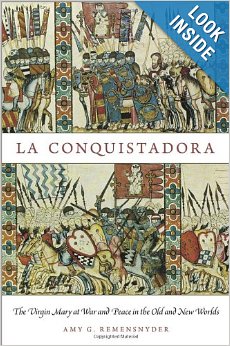
La Conquistadora: The Virgin Mary at War and Peace in the Old and New Worlds, by Amy G. Remensnyder

La Conquistadora is the next book I will be reviewing for H-Net.  I’m not even halfway through this massive book–in its chronicling of the Reconquista of Iberia from the Moors, I have only just now reached the crucial year of 1492, only to see it backtrack a bit in Part II to talk about how Mary was an object of veneration for Muslims and Jews as well as Christians, even as she was also called upon by Spanish kings and aristocrats to fight on the side of Christian armies.  In the third section, Amy Remensnyder’s book will discuss Mary’s career in this hemisphere, which, given my book’s interest in discussing (New Spain’s) Virgen de Guadalupe, should make for engaging reading–not that it hasn’t been so far.  (What disappointment I feel is simply that I’m not further along in reading it than I am, and not with the book itself.)

Already, though, some of the claims Remensnyder has made about how Mary has been invoked and venerated during the Reconquista seem to mesh with observations made by Serge Gruzinski regarding miraculous apparitions of the Virgin in Tenochtitlan/Mexico City in his crucial book on Mexican iconology, Images at War: Mexico from Columbus to Blade Runner (1492-2019).  Below the fold, I want to talk my way through some of that without making an argument, seeing that, as I noted, I haven’t yet reached Remensnyder’s discussion of Mexico.  But I especially want to muse a little on her elegant phrase “Marian geography.”  I’m betting she will use it when discussing this hemisphere, but (again, without yet knowing what she”ll say) I’d like to try to put a New World spin on that phrase that differs from the one it has so far had in her book.

Continue reading

Book-project Progress

It is the last day of July; next week, I will turn away from daily work on Domestic Issue in favor of getting things ready for the new semester, which begins in three weeks.  So, mostly just for me (but also, obviously, for anyone who happens to come upon this post), I thought I’d post a little “How I Spent My Summer, Scholarship-Wise” post.

Continue reading

The Land as Character in New World Writing: Some Initial Comments

John processing Nash

The keeper of this blog, processing–yes, let’s call it that: “processing”–Roderick Nash’s Wilderness and the American Mind, June 2015. Photograph by Megan Buaas.

In the Columbus chapter of the book project, I am at a place where I am trying to noodle my way through the idea that it is this hemisphere’s land’s There-ness, its resistance to being read in such a way as to conform to Europeans’ previous knowledge and assumptions about the world, that renders if not nonsensical then at least inaccurate not just Columbus’s claims that he had found Asia but, even, Europeans’ invention of the term New World–after all, Peter Martyr’s term in its essence simply says that this place fits neatly into what was already known about the world; Europeans just hadn’t known about this particular part of it before.  On the other hand, though, I’m trying to show that New World as appropriated by this hemisphere’s peoples does make rational sense because they do take into account, a priori, the land’s Thereness.  To that end, I have been reading/thinking through/writing a section in that chapter where I am presenting an overview of various writers and thinkers from throughout the hemisphere who in some way address how the land influences culture.  From there I’ll move on to making my argument for a different way of reading the texts of this hemisphere (that part is already pretty much written).  Very indirectly in this post on an early modern map of Tenochtitlan-Mexico City, I’ve already touched on this subject via my passing mention of Edouard Glissant’s argument about the land as character and my other reading of Latin American writers this summer has led me to other writers who seem to be saying much the same thing as Glissant without too much squinting on my part.  So, for the past couple of weeks I have been reading around in cultural writing from the United States from the 19th century, along with more recent interpretations of that writing, to see if somewhere in there might be traces of that same idea of the Thereness of the land and its fully-participant role in the shaping of culture.  The short answer is that, the Transcendentalists aside and much to my surprise, there really isn’t.

Below the fold, as I say in this post’s title, some comments; no real arguments, just some observations.  The more I think about this topic, the more I realize there is to say on it.  It’s not something I will pursue at any great length in the book project, but it will help me to enhance some thinking of mine in subsequent chapters–especially my discussion of Go Down, Moses, a novel in which the land figures prominently in Ike McCaslin’s thinking about his family’s history.

Continue reading

Comments on “A Voyage to South America” at the Art Institute of Chicago

cuzco-lady-bethlehem

Our Lady of Bethlehem with a Male Donor. Cuzco, 18th century. Image found here.

This past weekend, my wife and I were in Chicago, ostensibly to attend a friend’s wedding.  We turned that into an excuse, however, to arrive a few days ahead of time and do some sightseeing: my wife had never been to Chicago before and I’d last been there over 20 years ago, so much of the time I felt much the same as she did about what we saw.  It was a good visit, filled with good sightseeing and, thanks to my wife’s foodie soul, good food as well.  Before we left Wichita, I made sure to check the Art Institute’s list of current exhibitions, and I was pleased to learn that one of them was A Voyage to South America: Andean Art in the Spanish Empire.  It’s a small exhibit (only 16 items); but, seeing as I don’t believe I’d seen any colonial art from the Andes in person before, I was glad to have the chance to see what I did.  This exhibit is the first of its kind for the museum and will remain up until January of 2016, so anyone who will be in the area between now and then who has an interest in Spanish colonial art should give this a look.

Casta Figures in a Landscape

Antonio de Ulloa, Jorge Juan. “Casta Figures in a Landscape,” from The Historical Relation of a Voyage to South America, 1748. Photograph by Megan Buaas.

I’m pretty much ignorant of Peru’s colonial history, I am sorry to say.  Peru was equally Mexico’s rival in terms of its wealth, and its society became as racially mixed as New Spain’s became, but that really is about all I know.  Based on my reading about casta paintings in New Spain, though, I know that so far only one set of casta paintings from Peru is known to exist.  This fact strikes me as strange, given, for example, the illustration by Ulloa and Juan that you see here–the castas themselves are not only known, it appears that, as was the case in Mexico, certain standard ways of depicting them had appeared as well.  (By way of comparison, over 100 complete sets of casta paintings from Mexico are known to exist.)

The other, serendipitous fact of my seeing this exhibit when I did is that I have been reading a recent history of Spain’s exploration of and colonizing efforts in the Pacific, so the art work here provided a nice visual complement to that reading.

Of course, no exhibition purporting to cover 300 years of colonial art via 16 objects is going to go too much into depth.  Its chief virtue for me, therefore, was in showing me that, despite my reading of that history, I have still more reading to do.