First book review

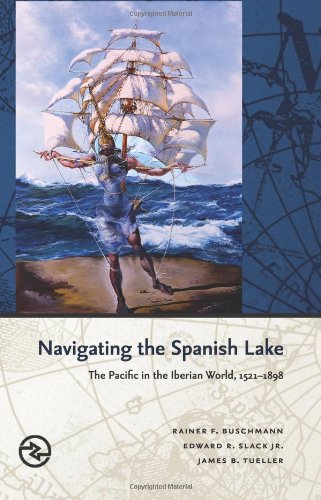
NavigatingI am now officially in the book-reviewing business for H-Net, and the image you see here is the cover of the first book I have reviewed.  Here is the link to the review itself, in case you’re interested.  This isn’t the sort of book you’ll be foisting on other people as a test of whether you and they can be friends, but it does do what it says it will do: it seeks to alter historians’ prior assumptions about Spain’s control of the Pacific Ocean as having been pervasive and pretty much unchallenged at least until it lost control of its colonies in most of the Americas.  Its prose is serviceable but, as I note in the review, its goal of appearing to have been written by one author (three authors are credited on the cover) gets undermined by some editorial choices, which caused me to become distracted by the question of just who was most responsible for what chapters.

As these reviews get published, I will also be posting links to them under the “Reviews” tab on the blog’s home page.

Comments on “A Voyage to South America” at the Art Institute of Chicago

cuzco-lady-bethlehem

Our Lady of Bethlehem with a Male Donor. Cuzco, 18th century. Image found here.

This past weekend, my wife and I were in Chicago, ostensibly to attend a friend’s wedding.  We turned that into an excuse, however, to arrive a few days ahead of time and do some sightseeing: my wife had never been to Chicago before and I’d last been there over 20 years ago, so much of the time I felt much the same as she did about what we saw.  It was a good visit, filled with good sightseeing and, thanks to my wife’s foodie soul, good food as well.  Before we left Wichita, I made sure to check the Art Institute’s list of current exhibitions, and I was pleased to learn that one of them was A Voyage to South America: Andean Art in the Spanish Empire.  It’s a small exhibit (only 16 items); but, seeing as I don’t believe I’d seen any colonial art from the Andes in person before, I was glad to have the chance to see what I did.  This exhibit is the first of its kind for the museum and will remain up until January of 2016, so anyone who will be in the area between now and then who has an interest in Spanish colonial art should give this a look.

Casta Figures in a Landscape

Antonio de Ulloa, Jorge Juan. “Casta Figures in a Landscape,” from The Historical Relation of a Voyage to South America, 1748. Photograph by Megan Buaas.

I’m pretty much ignorant of Peru’s colonial history, I am sorry to say.  Peru was equally Mexico’s rival in terms of its wealth, and its society became as racially mixed as New Spain’s became, but that really is about all I know.  Based on my reading about casta paintings in New Spain, though, I know that so far only one set of casta paintings from Peru is known to exist.  This fact strikes me as strange, given, for example, the illustration by Ulloa and Juan that you see here–the castas themselves are not only known, it appears that, as was the case in Mexico, certain standard ways of depicting them had appeared as well.  (By way of comparison, over 100 complete sets of casta paintings from Mexico are known to exist.)

The other, serendipitous fact of my seeing this exhibit when I did is that I have been reading a recent history of Spain’s exploration of and colonizing efforts in the Pacific, so the art work here provided a nice visual complement to that reading.

Of course, no exhibition purporting to cover 300 years of colonial art via 16 objects is going to go too much into depth.  Its chief virtue for me, therefore, was in showing me that, despite my reading of that history, I have still more reading to do.

Teaching Idea: “The ‘John Henry’ Variations”

John_Henry statue, Talcott, Summers County, West Virginia

Statue of John Henry, Talcott, Summers County, West Virginia. This is one of two sites (the other is in Alabama) that lays claim to providing the historical foundation for the story of the competition between John Henry and the steam-driven machine. Via Wikipedia.

Actually, this isn’t so much a Teaching idea as it is a nudge to me to do some archival stuff in the future in support of a Teaching Idea.

For a few years now, I’ve had the idea of using the multitudinous pre-WWII versions of “John Henry” as a way of getting adventurous students to think about and speculate on the subjects of American legendary figures, the mechanization of labor, differences and similarities between white and black attitudes about labor, and–heck, why not?–even thinking about music itself in an age before music-making and -marketing had become a national industry.  Well, you can probably guess, just from that little description, that none of my students has yet taken this up as a research project.  Some of that’s on me and how the prompt is written: it’s just too busy.  But some of it is surely due to the scattered nature of the materials themselves, not to mention the rather ephemeral nature of the Web itself: as a source for my students, I had been relying on one blog’s round-up of around 100 versions of “John Henry” or songs that in some way addressed that tradition . . . and then that blog just went away.

So, I changed the prompt to refer students to YouTube, just telling them to go trawling around in there for different performances, but that breaks one of my rules for assignment design: Don’t ask students to do anything you yourself wouldn’t want to do.  I must have subconsciously given up on the idea because I hadn’t felt especially motivated to do anything to improve it.  But this morning, I read this long article by Ann Powers at npr.org on the current state of the archiving of music on the Internet, and a voice inside my head said, “Hey!  Why don’t YOU build a ‘John Henry’ archive?”

So.  It won’t be this summer because of book-project stuff, but this fall or next spring that’s what I’ll be doing.  It’ll have some links to historical stuff, but its main focus will be on the songs themselves, along with background information, wherever available, about the performers.  I’m persuaded that the number and variety of this/these song(s) can tell the thoughtful listener a great deal about us as a nation, or us as we existed around a century ago; maybe, with the existence of one centralized place for recordings and some information, I can encourage my students (and whoever else might happen upon it) to think about those things, as well.

EDIT: Before I forget it, there was, accompanying the Powers article above, this round-up of good online archives of music, some of which will come in handy once I get started on this thing.
Some comments on Russo, casta paintings, and the New World as a heterotopic space

The Untranslatable Image

The Untranslatable Image: A Mestizo History of the Arts in New Spain, 1500-1600. Amazon link here.

I still haven’t finished reading Russo’s book, but it’s a measure of the value it has for me that a quick perusal of the last chapter persuaded me to ::sotto voce:: copy it.  It was either that or incur the wrath of the good people at the U. of Kansas’ Watson Library’s interlibrary loan department for being late in getting their book back to them.  Anyone who likes Serge Gruzinski’s book The Mestizo Mind (an important book for Russo’s work) and/or is looking for a very different way of looking at and thinking about the artistic production of New Spain in its first century will want to look at this book.

Given that Russo’s book’s coverage ends where it does, she does not mention casta paintings.  However, as I have thought about her close, attentive discussions of maps serving as not only accurate renderings of physical space but also as their indigenous or mestizo makers’ attempts to make new, conceptual sense of their home, which, now that the Spaniards have arrived, has caused their land to be turned upside-down (a phrase she quotes at least two indigenous and mestizo chroniclers as using), it occurs to me that we could also discuss casta paintings in those same terms.  They, too, were made mostly by mixed-race people; they, too, were the visual records of a Crown-sanctioned attempt to impose order on a bewildering variety of racial combinations; and/but they, too, they seem to be about more than the business of reinforcing the Crown’s legal, political, and social hierarchies.  (This seems especially true of the paintings done toward the end of the colonial period.)  In other words, the casta paintings can be said to serve as kinds of maps, as well, complete with “directions” (in the form of the names of some of the different castas), that also reflect at some level their makers’ own sensibilities as they paint people whose racial types they know–indeed, as they occasionally paint their own racial types–types, moreover, that didn’t exist before the arrival of Europeans and, later, people of African descent.

Below the fold, I have examples of three casta paintings that I hope will help illustrate what I am getting at.

Continue reading

Teaching Idea: Build Your Own Micronation

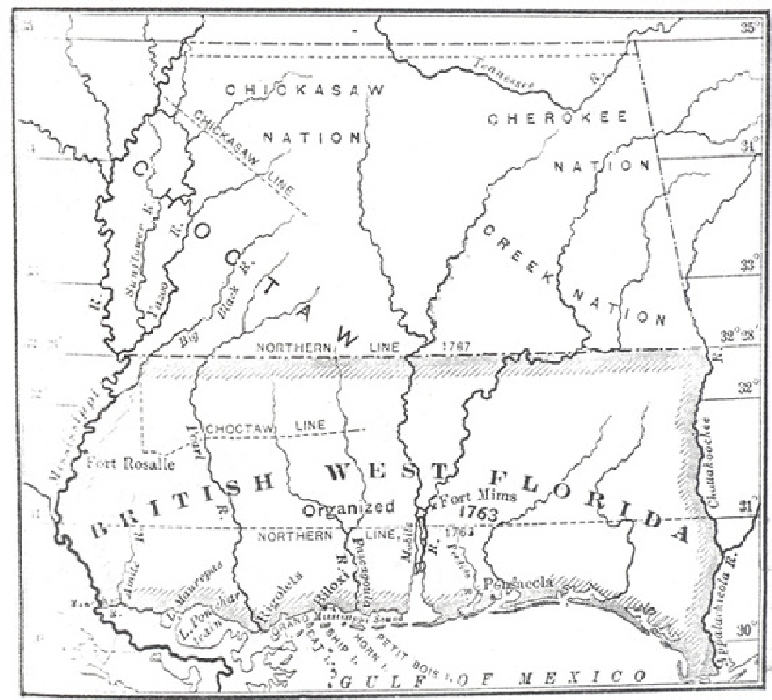
West_florida_map

18th-century map that serves as the basis for the territorial claims of the micronation of the Dominion of British West Florida. Image via the “History” page of the Dominion’s website, here.

Note: Occasionally, as happens with all teachers, I’ll read something that will lead me to think, “With a little pushing/pulling/mulling over, that just might make for a good writing assignment for my students.”  So, some of those will appear here under the “Teaching Idea” category that you’ll see over in the right-hand gutter.  I don’t pretend that these are in any way finished; rather, these are more like my thinking “out loud” in this space, with a tacit invitation to whoever might be interested to weigh in with comments.

A couple of weeks ago, I read this article on micronations in Motherboard and immediately thought it might have potential for a research project for my Comp II students (that is the “research paper” composition class we teach at Butler).  Almost immediately, other things came up that claimed my attention, and I didn’t do anything more with the idea until yesterday when an article on the Dominion of British West Florida popped up in my Facebook feed, and the next thing you know, I found myself adding some links to micronation websites over on the right-hand side of my blog as a future resource for my students.  We in our department are moving toward demanding more research from our students throughout the Comp sequence, and I think that, at least as this half-formed thing looks in my head at the moment, it would certainly fulfill that goal.  Also, I want to give those so inclined the opportunity to be creative and/or learn more about a topic or issue they think is important; the Motherboard article’s mention of Westarctica‘s serving primarily as a site to inform people of conservation issues and climate change made me see that this project could be serious as well as fun.  Finally, the idea of micronations dovetails in interesting ways with my academic interests in the idea of place and, in conjunction with the book project, with the idea I’ve been writing about regarding the New World as a heterotopic space.

So here’s a tentative list of elements that I will require my students to address in this project.

Teaching/Academic blogs and resources

I have been busy adding links to colleagues’ own blogs as well as ones they’ve suggested over in the sidebar.  It’s a short list, as you can see, but I want to grow it; so, if you have a teaching or academic blog, or you sometimes visit such a place for ideas or inspiration, I hope you will include links to them here in the comments or on Facebook.

Also, for anyone interested: under the new tab titled “Domestic Issue–Online Resources,” I have some links to sites that may be of interest to people doing research in “literature of the Americas”-type stuff.  Again, the list is short (over time, some truly valuable sites have been taken down); but, again, I hope that if you have some suggestions, you’ll let me know here in comments.

The Re-mapping of the World

Map of Tenochtitlan and Gulf Coast, 1524. Via mesolore.org.; you can find a larger, zoomable version here.

I am not as far along in Alessandra Russo’s fascinating book The Untranslatable Image as I should be, seeing as I have it through inter-library loan and it’s due back next week.  That said, her brief discussion of this map of the just-conquered Aztec capital of Tenochtitlan is, in and of itself, too rich to go unremarked upon.  Even more important for me of late, this map–that is, the circumstances of its making–seems to intersect in a very material way with a much more abstract idea I have been kicking around regarding the Columbus chapter I have been working on: Following Edouard Glissant’s argument in Caribbean Discourse that the land is a central character in and even producer of Caribbean culture, I want to make the argument that it’s the land’s resistance to being read as Columbus would have it read that invalidates the Europeans’ invention and adoption of the term New World yet also allows the new peoples of this hemisphere to re-appropriate that same term to describe this space, and even set about re-ordering the Old World’s perception of itself relative to the rest of the planet. This will have to get worked out elsewhere, alas. In the meantime, though, here are some thoughts on Russo’s discussion of the making of this map: Continue reading

Content now up under “Teaching”

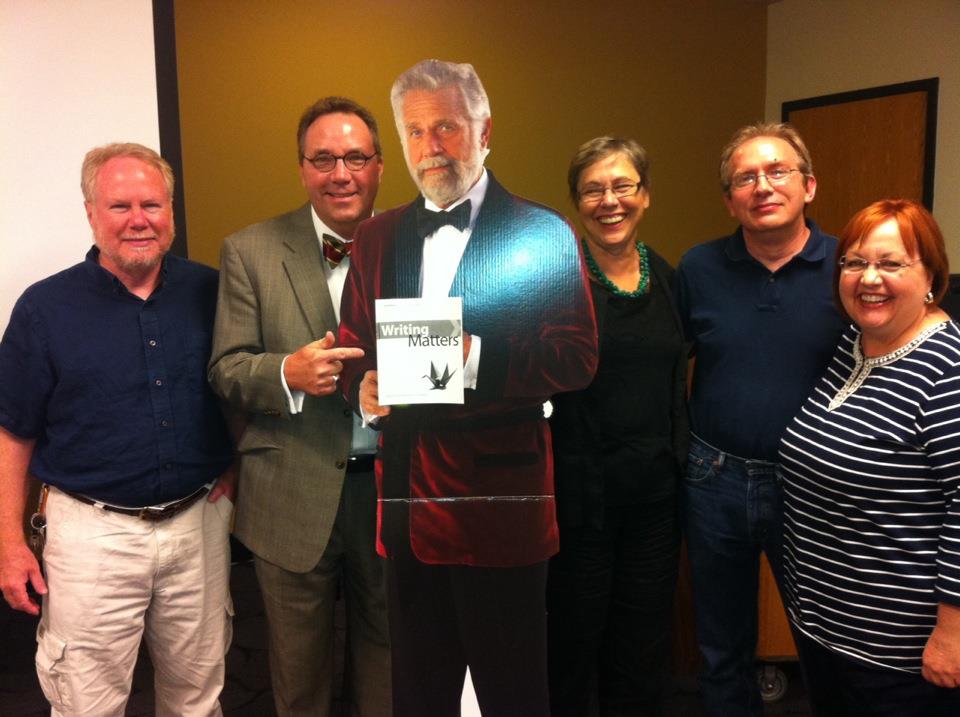
The Most Interesting English Department in the World

A few years ago, our department meeting was graced by two luminaries: Rebecca Moore Howard (author of Writing Matters, our department’s grammar text), and the ever-mysterious, ever-fascinating Most Interesting Man in the World.

In case anyone is interested, on the “Teaching” page I now have a round-up of assignments I’m especially pleased with, along with a narrative that talks about how some of them, at least, came into being.  I hope you will enjoy what you find there.

New summer, new start on a blog

It’s a long story, but I am compelled to rebuild the original Domestic Issue blog, and so I thought I might as well include pages with teaching stuff as well.  So, this is the new place, which will be under construction for a while.  I hope you’ll like it and leave comments and constructive criticism as you see fit.