The cover of a Brazilian(?) edition of Amado’s novel, via (though this particular copy of the book is no longer for sale at that site).
I have begun my reread of Brazilian writer Jorge Amado’s novel Tent of Miracles, which I have paired with Faulkner’s Go Down, Moses in chapter 2 of the book project. I’ll start off this post by making a couple of points regarding Ike McCaslin’s relationship to the land, and then I’ll make some comparisons between that and Tent of Miracles‘ treatment of Bahia, along with some initial remarks comparing Ike to Tent of Miracles‘ protagonist, Pedro Archanjo. A good starting point for where I will be headed, though, is to compare the cover art for the Amado novel (which appears to be a scene from the 1977 film version) with that of the first edition of Go Down, Moses, which I posted here. Though admittedly a bit of a cherry-pick on my part, that cover, with its depiction of a vast landscape empty of people, contrasted with the cover of Amado’s novel–the frame crowded with people, dressed and equipped with a fusion of Western and African-diaspora clothes and instruments–serves quite nicely as a starting point for this post.
A new year and a new semester are upon us, and I will be meeting students this week, some of them whom I’ve had in class before, and some for the first time. I will be saying “Welcome to class” to all of them, of course; but if you–yes, you, the person now reading the very sentence I am now writing–have found your way here because you happened to see the URL address for this blog in your syllabus and became curious (I really am speaking to you in particular), then allow me to speak to you for a bit.
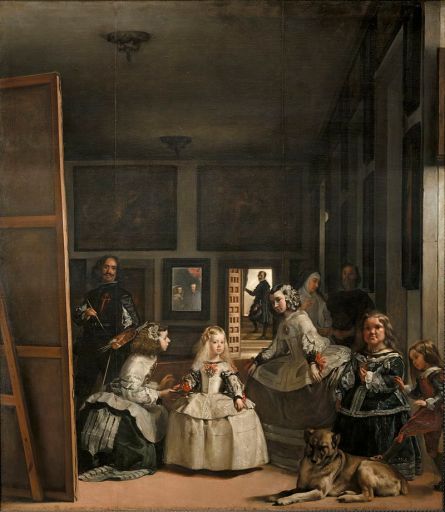
Later this semester, some of you will see the Velázquez painting you see here as part of an introduction to a writing assignment, but for the moment I’d like to put it to another use: to think of what you see here as something like a representation of the educational experience and, thus, to invite you to answer a perhaps not-so-simple question–“Where are you in this painting?”
A sharecropper’s house, with cotton and sweet potatoes on the porch. Knowlton Plantation, Perthshire, Mississippi, 1939. Via.
To the reader: This is a follow-up to my most recent post. It’s not crucial that you read that one before proceeding with this one, but it certainly wouldn’t hurt.
I think that what follows is more speculative than anything else; whatever legitimacy these claims have rests on the textual fact that the “now” of Go Down, Moses‘ section “The Fire and the Hearth,” set in 1941, takes place (depending on whose genealogical chart one consults) one or two years after the “now” of “Delta Autumn,” even though sequentially, “The Fire and the Hearth” appears second in the novel, while “Delta Autumn,” appearing sixth, serves as the novel’s climactic section. Thus, even though Roth Edmonds (who figures prominently in both) never hints, not even obliquely, in “The Fire and the Hearth” that he’s ever had a lover, much less that she was a black woman by whom he’d conceived a child, and very much less that, as we learn in “Delta Autumn,” she and Roth are distant cousins, it’s reasonable to begin by assuming the events we learn of in “Delta Autumn” have a shaping influence on Roth’s actions and, more crucially, thinking in “The Fire and the Hearth.” The trick is in the locating of those influences. Maybe I have found some of those moments, without being guilty of squinting too hard at them.
(Note: What with the beginning of the new semester all but upon me, I really shouldn’t be taking the time I’m taking to post on this at all, much less shape it into a more elegant form; what follows, then, are more like notes than anything else.)
The McCaslin-Edmonds-Beauchamp genealogy in Go Down, Moses. Via.
Go Down, Moses is a tangle of a novel, both chronologically and genealogically, as this chart shows. I already knew these things, of course. In the course of my rereading, though, I am finding it to be even more tangled than in just the ways I had realized or had intended to address in the book project. Two of those tangles are the sequencing of the stories (almost all of which, just to remind the reader, had prior existences as short stories) and the material Faulkner added to them in order to unify them into his novel. The sequencing has nothing to do with chronology but, I am rather sheepishly realizing, with the gradual revelation of the extended McCaslin genealogy; the link to the webpage where I found this chart does a good job of tracing out the tree as each novel’s section in its turn reveals its branches. (In this regard, Go Down, Moses‘ gradual, decidedly unchronological revelation of information from various sources/directions most strongly resembles Faulkner’s other great examination of the tragedy of slavery, Absalom, Absalom!) But more to the point of this post, I have found myself paying closer attention to Carothers “Roth” Edmonds, whom the novel introduces us to in “The Fire and the Hearth.” Roth is the man who now owns the McCaslin plantation that Ike McCaslin had refused to accept as his inheritance, and he is also, as we’ll learn in “Delta Autumn,” the father of the baby the woman brings to the hunting camp in hopes that maybe, finally, Roth will acknowledge them. Lucas Beauchamp is “The Fire and the Hearth”‘s central figure, but he will barely figure into Go Down, Moses‘ other sections. Rather, it is through Roth that “The Fire and the Hearth” introduces the novel’s central mystery: Why Ike has refused to take ownership of the family land. This post’s subject, though, is a smaller mystery, one that, for me, anyway, has the potential to make Roth a more sympathetic figure than most take him to be.
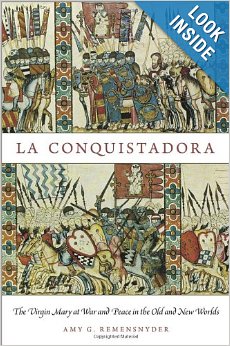
I (finally!) finished reading Amy G. Remensynder’s book La Conquistadora: The Virgin Mary at War and Peace in the Old and New Worlds, and have sent off a review of it to H-Net; I’ll post a link to it as soon as it’s published there. Here, I thought I’d add some remarks that didn’t make it into the review but which have a bearing on the book project, at least some of which amount to editing my earlier remarks here.
(Disclaimer: One of my Comp II students has chosen to write his film analysis paper on Koyaanisqatsi–the first time a student has written on that film. (I give them a list of about 50 films from which to choose; all the Qatsi films are on it.) Thus, Godfrey Reggio’s lovely, haunting, non-narrative film has been much on my mind of late, and today I remember this thing from long ago that I’d written at my old blog, with my dog as its protagonist. It still makes me laugh, and maybe it will make some of you smile, too.)
(with deepest apologies to Godfrey Reggio, Ron Fricke, and Philip Glass, and with many thanks to Megan for inspiration.)
A horizontal line of red dots and dashes against a black background. Glass’s haunting organ piece plays, and a bass profundo chants, “KoyaaniScruffy.” The dots and dashes gradually lengthen vertically into the TITLE.
SCENE: Desert petroglyphs
Solemn, totemic-looking figures, charcoal against reddish-yellow rock. The camera pans back very very slowly. Same music. The camera reveals one of the figures to the right, bent down, swatting at an animal humping his leg. As the animal comes into view, the bass profundo resumes chanting the TITLE.
SCENE: Aerial views of Monument Valley
The music continues, the chanting stopped for the moment. We see nothing moving at all for as far as we can see, as the camera shows us shot after lingering shot of these magnificent formations rising abruptly from the desert floor. This sequence goes on for at least a couple of minutes. Finally, far away but in the foreground of one of these shots, we discern a small cloud of dust in the desert. The camera moves in slowly, ever so slowly; as we get closer, we can gradually discern a gangly wirehaired dog on his hindlegs, pirouetting about within a dust-devil. The bass profundo chanting of the TITLE resumes. This should be shot in the slowest of slow-motion. Close-up of the dog; we can see his mouth agape, his tongue dripping with saliva, the happy and/but crazed look in his eye. The viewer should feel a nameless, soul-numbing horror, as though s/he is seeing a riderless Horse of the Apocalypse.
The remaining sequences in the film reveal Scruffy to be omnipresent: contemplating rivers of clouds from the summits of mountain peaks; contemplating real rivers as they turn into waterfalls; then, in scenes shot in New York and Los Angeles, frenetically chasing cars, running amok among commuters in subway stations, urinating on fire hydrants as little kids play in their spray, etc. Two extended sequences are of special note. In the first one, after we see several large, abandoned public-housing projects come crashing down, the dust slowly clears from the last one we see, revealing Scruffy with a single brick in his mouth, trotting away happily, stopping to urinate on an abandoned swing set and sniff at a McDonald’s bag blowing about. The other, shot inside an Oscar Meyer packaging plant, shows Scruffy watching, patiently watching, as we watch hot dogs being packaged by machines, then suddenly snatching one of the packages off a conveyor belt and merrily running about while workers chase after him: in part an homage to the famous chase scene in the factory in Modern Times, no doubt. The workers never catch him. He is too fleet, too agile. More: he is simply beyond them. It is as though he is a will-o’-the-wisp, a desert djinn come to wreak havoc on a secularized world turned blind and, thus, vulnerable to the spirit realm’s machinations.
SCENE: Brightly-lit kitchen.
Same organ music as at the beginning of the film. Tight shot of an empty dog food bowl, Scruffy’s snout sticking into the frame from the left. The camera slowly pulls back. Scruffy slowly looks up, licking his lips (this sequence is shot in excruciatingly slow motion). From the top of the frame, a cascade of dry dog food pours into the bowl. The viewer trembles as s/he realizes: some human agency gives sustenance and shelter to this wire-haired Cerberus?? Monstrous. Perverse. The food ceases to pour. Scruffy watches, then looks down. The TITLE is chanted once, twice. At the third chanting, as if on cue, Scruffy suddenly plunges his mouth into the food bowl, causing some of the kibbles to fly up as it they were droplets of water. The camera isolates on one of the kibbles, higher than the others, slowly spinning in the air as it descends, the kitchen light glinting on its surfaces, revealing its golds and reds as it turns, turns. It lands on the floor, rolls, stops. We watch. The music and chanting continue. We watch, watch; then suddenly a blur as Scruffy erupts into the frame to eat the kibble and just as suddenly disappears. The music ceases; the scene goes dark; then . . .
CLOSING SCENE: Desert petroglyphs
The camera is tight on the petroglyph showing the dog humping the figure’s leg. We are left in silence to ponder this image and ask ourselves, What have we learned?
The first-edition (1942) jacket for the novel Faulkner wanted to be called simply Go Down, Moses. Image found here.
It’s been a while since I have reported on my progress on the book project. I thought I’d use this post to both comment on that and to do some sketching out of some work on it I’ll be taking up over the Christmas break. To spare the uninterested, the rest of this post will appear below the fold. If you do click to read on, apologies in advance for some of the Inside Baseball quality of what you’ll run into.
I first learned of political philosopher Giorgio Agamben earlier this year via this long review article by Adam Kotsko in the Los Angeles Review of Books. Since then, I’ve not exactly been a diligent student of his, but Kotsko’s discussion of Agamben’s book The Highest Poverty: Monastic Rules and Form-of-Life, struck me as having resonances with Foucault’s notion of heterotopia which, as the tens of readers of this blog may recall, has considerable importance for my book project. My long-time Internet friend Kári was kind enough to send me a copy of that book when he learned of my interest in Agamben, and he also has the useful habit of posting things about Agamben on his Facebook feed from time to time.
Anyway, speaking of Facebook, this morning the video below popped up as a Suggested Post; it’s an 8-minute condensed presentation of Agamben’s central idea, the Homo Sacer, or “sacred man,” and its gradual loss as monarchies have evolved into democracies (and totalitarian states) and biology has become the chief determinant of the individual’s value in society. If any of this sounds the least bit interesting to you, I encourage you to watch this.
An Aztec mirror made of obsidian, with a modern wooden base. Museo de América, Madrid. Wikipedia Commons.
On my Facebook feed during the days leading up to the day traditionally known as Columbus Day, friends and colleagues posted discussions about proposals either not to celebrate that day, or that we instead honor Bartolomé de las Casas, or that, as the city of Seattle did this year, we should urge municipalities or states vote to change the name of the day to “Indigenous Peoples’ Day.” As I read these items, I found myself torn. I was and remain fully in sympathy with these suggestions for the reasons we all are familiar with; but I also wondered if they, well-intentioned though they were, weren’t equally as flawed in their attempts to honor the historical and cultural realities of this hemisphere.
“Someone” here just may be me, this morning anyway. Via xkdc.
Reading this article in Motherboard this morning led me to write down what you see below. I’ve labeled it “Teaching Ideas” but, as of now, I have no idea just what I mean by that. If you read all of this (and I hope you will, and I hope you’ll comment as the spirit moves you), just remember that the operative word in the title is “Notes”:
Research showing young people are less sympathetic/empathetic than their cohort of 30 years ago.
The rise of selfie-sticks; the “production of presence”; a technologically-enabled self-indulgence, if not full-blown narcissism. Turkle’s thesis in Alone Together: The very devices and platforms that allow us to be constantly in contact with/available to others also, paradoxically, keep us from being too inconvenienced by consideration of, let alone the actual emotional needs of, those same others. We keep others not even at arm’s length anymore, but at machine’s length–which by its very nature does not permit of genuine human contact. The rise of haptic technologies are a tacit recognition of this: the further enhancing of the illusion of a “realistic” experience when one is immersed in a virtual space.
IT industries’ isolating of their employees as much as possible from daily, mundane interaction with the world (via shuttles, self-contained campuses) even as they argue that the products they create will change that same world. As in the Motherboard article above, machines now really are building machines; the Invisible Hand of the market becomes ever harder to see.
Efficiences in education/rejections, in various ways, of the traditional educational model. Re: efficiences: Something that’s existed at least since Dewey, but computers, the growing potential of machines to learn, and Internet technologies create more temptation and/or pressure on schools at every grade level to educate more students more quickly at lower costs–marketed as convenience to students. Online classes, MOOCs, “robo-graders.” Re: rejections: Seen in the rise of homeschooling in response to rejection/fear of/denigration of public education; the parallel reduction of funding of (if not also, as in Kansas, active political hostility toward) public education and resistance to improving both salaries and preparation of teachers; the rejection of traditional collegiate model in favor of a kind of entrepreneurial, I’ll-learn-what-I-want-to-and-not-what-people-think-I-need-to-know approach to post-secondary education.





 Domestic Issue
